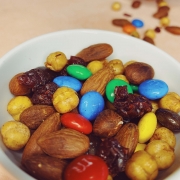
Hangry? Give this trail mix a go

Hangry;
Adjective
Bad-tempered or irritable as a result of hunger.


I first made this trail mix after many years of my partner, Jacob ending up hangry after work. Despite my constant suggestions (or should I say possible nagging) for him to start snacking in addition to his main meals throughout the day, nothing seemed to change. He did not like the things that I would usually eat for snacks, he found fruit, yoghurt, nuts, popcorn boring but was also not motivated enough to prepare a more “exciting” snack. So eventually I decided I needed to make something that was:

  1. Easy to make
  2. Could be made in bulk and stored safely for a few weeks
  3. Nourishing and filling
  4. Appealed to his sweet tooth

The below recipe is what I came up with. The amounts I used are only because they are the size of the bags you can buy these products in so feel free to play around with this recipe to make it into something you love.

You could try using different nuts, chocolate or dried fruit or adding popcorn or pretzels. If you have more of a savoury tooth, then you could try swapping the cinnamon for spices such as turmeric and cumin and swapping the chocolate for additional nuts, chickpeas or popcorn.

As an additional note, I am pleased to say that once he got into the habit of snacking, he realised how much better he felt and now he snacks on all sorts of things! (We still always have a back-up container of this trail mix ready to go)

Trail Mix

Course: Snack

Ingredients

  • 200 g lightly salted roasted chickpeas
  • 150 g dried cranberries
  • 180 g  m & m’s (choose your favourite)
  • 450 g natural almonds
  • 1 tsp cinnamon

Instructions

  • Preheat oven to 160 °C.
  • Combine almonds and cinnamon in a large bowl and toss to coat the almonds in cinnamon.
  • Spread almonds evenly onto a baking tray. Bake in the oven for 10-15 minutes or until browned.
  • Immediately place almonds back into a large bowl and allow them cool completely before adding the remaining ingredients and mixing together.

Have you ever heard the saying eat the rainbow? Well, this is a great way to do it.

Fruit and Vegetables fall into 5 different colour categories and each colour category has its own unique set of phytochemicals that not only give the fruit and veg their colour but also come with their own unique set of health benefits.

Colour Examples Benefits
Red Tomato, Red capsicum, Strawberries, Raspberries Red fruits and vegetables contain a natural plant pigment called lycopene which is an antioxidant that helps to reduce the risk of cancer and keep our heart health.
Purple/Blue Beetroot, Red cabbage, Blueberries Purple fruits and vegetables are coloured by a natural plan pigment called anthocyanin. This pigment has antioxidant properties that help to protect our cells from damage and reduce the risk of cancer, stroke and heart disease.
Orange Carrots, Sweet Potato, Mango, Apricot, Pumpkin Orange fruits and vegetables are given their colour by carotenoids. A well-known carotenoid is beta-carotene which is converted into vitamin A and helps to protect the mucous membranes and maintain good eye health. Another well-known carotenoid is lutein. Lutein is stored in the eyes and helps to prevent cataracts and age-related macular degeneration.
Green Cabbage, Spinach, Cucumber, Green Apple, Green Grapes Green fruit and vegetables contain a range of phytochemicals which help to reduce the risk of cancer but also some of our green fruits and veg are great sources of folate, which is especially important during pregnancy.
Brown/White Cauliflower, Mushrooms, Garlic, Ginger, Banana White and brown fruit and vegetables also contain a range of phytochemicals. An example is allicin, found in garlic which is known for its antiviral and antibacterial properties.

This salad is a great way to get plenty of colour on your plate! This recipe does make about 8-10 serves so it is a great option when you are catering for a large group or if you want ot have leftovers for the next few days.

What should I serve this salad with?

We love this salad with our salmon and sweet potato patties although we also love it with some cooked shredded chicken and have even served it with Korean style chicken tacos.

Crunchy Asian Style Slaw

This salad is a great way to get plenty of colour on your plate! This recipe does make about8-10 serves so it is a great option when you are catering for a large group or if you want to have leftovers for the next few days.
Course: Salad
Keyword: Anti-inflammatory, Vegetarian
Servings: 10 people

Ingredients

  • 1/2 red cabbage shredded
  • 2 large carrots grated
  • 3 spring onion finely sliced
  • 1/3 cup slivered or chopped almonds roasted

Dressing

  • 2 tbsp rice wine vinegar
  • 1 tbsp soy sauce
  • 1 lime juiced
  • 2 tbsp sesame oil
  • 1 tbsp honey
  • 2 cloves or tsp garlic crushed
  • chilli to taste

Instructions

  • Combine all ingredients in a jar or bowl and shake or stir until well combined.
  • Combine all salad ingredients in a large bowl and mix to combine.
  • Pour over the dressing and toss to combine.

Notes

Time saving tip: if you don't have all the dressing ingredients that you need or are short on time you can replace the dressing with a store brought one such as Pandaroo Vietnamese Salad Dressing or Birch & Waite Asian Sesame Soy and Ginger Dressing. Simply replace with 3 tbsp of your chosen dressing.

Do you get your 2 serves of fish per week? Give these Salmon and Sweet Potato Fish Cakes a try

Atlantic Salmon has at times been referred to as a “superfood” and while there is no single food that can be held above all others, I agree that salmon offers a range of health benefits. Just 100g of salmon naturally contains over 150% of the recommended daily intake of Omega-3 fatty acids. On top of this salmon is a great source of protein, zinc, magnesium, Vitamin B and Selenium. The Australian Heart Foundation recommends that all Australians should eat two or more serves of fish per week as a part of a health and balanced diet.

Research suggests that regular consumption of fish may be associated with reduced risk of cardiovascular disease, dementia, childhood asthma and age-related macular degeneration. It has also been shown that regular fish consumption can support improved blood sugar control in people who have diabetes and assist in relieving symptoms associated with inflammatory conditions such as rheumatoid arthritis, psoriasis and autoimmune diseases.

Despite the range of positives associated with regular consumption of fish, unfortunately a lot of Australians still do not eat fish regularly. This recipe is a great way to incorporate fish into your diet. You can make these fish cakes with either fresh or canned salmon, so for those budget savvy people out there can get enough salmon to make this recipe for under $5.

What if I don’t like salmon?

This recipe is great for people who do not like the taste of fish as the strong flavours of ginger, garlic, and lemongrass mean that these fish cakes do not have an overwhelmingly fishy taste. Although if you don’t like salmon, you can also substitute the salmon for any other canned or firm fresh fish that you enjoy.

What should I serve these with?

Serve these hot or cold with your favourite salad or vegetables. I love these fish cakes served with my Crunchy Asian style slaw and will often make a delicious yoghurt dipping sauce to have with them by simply mixing a few tablespoons of Greek yoghurt with 1-2 tsp of sriracha. They also make a great snack!

Salmon and Sweet Potato cakes

Do you get your 2 serves of fish per week? Givethese Salmon and Sweet Potato Fish Cakes a try
Course: Dinner, Lunch
Cuisine: Australian
Keyword: Salmon, Sweet Potato

Ingredients

  • 450 g fresh or canned salmon
  • 1 large, sweet potato, peeled and roughly chopped into 3cm cubes
  • 3 spring onions, finely sliced
  • 1 tsp chilli paste
  • 1.5 tbsp lemongrass paste
  • 2 tbsp minced garlic
  • 1 tbsp minced ginger
  • 1 tsp cumin
  • 2 tsp brown sugar

Instructions

  • Pre-heat oven to 180°C. Place the salmon fillets on a lined baking tray. Place in the oven and cook for about 10-12 minutes. (It is ok if the salmon is not cooked all the way through as it will be cooked further) Once cooked remove from the oven and set aside. Note: if using canned salmon, skip this step instead open and drain the salmon and set aside.
  • Meanwhile, place the sweet potato in a medium saucepan and add enough water to cover the sweet potato by an additional 3cm. Cover with a lid and bring the mixture to a simmer over a medium-high heat. Once simmering, reduce the heat to medium and simmer, covered for approximately 8 minutes or until the sweet potato is tender or easy to prick with a fork.
  • Once tender, drain the sweet potatoes well and return to the pot. Mash the sweet potatoes using a masher until there are no large chunks left then add the cooked salmon fillets and continue to mash until the salmon and sweet potato are combined.
  • Add the spring onions, chilli, lemongrass, ginger, garlic, cumin, fish sauce and brown sugar and mix well to combine.
  • Scoop 1 heaped tablespoon of the salmon and sweet potato mixture and form into a ball with your hands. Place on a plate or a tray and place in the fridge for a few minutes to firm up slightly.
  • Meanwhile heat 1 tsp of Extra Virgin olive oil in a large non-stick frying pan, over a medium-high heat. Once hot add about 1/3 the fish cake balls to the pan and squash down slightly with a spatula or fork. Cook for approximately 2-3 minutes on each side or until golden brown. Transfer to a plate or tray and cover with foil to keep warm. Repeat step 6 until all fish cakes are cooked.